
Through their Rainbow Local Government program, the LGBTQIA+ industry has quietly infiltrated city councils across Victoria. Public toilets, showers and changerooms meant for girls and women are now open to men.
Featured: Dean Hurlston, Moira Deeming, “Rebecca,” Alex, Kit Kowalski
Listen Now
Transcript
Click here to read the episode transcript
Protesters: SACK THEM ALL! SACK THEM ALL! SACK THEM ALL! SACK THEM ALL! SACK THEM ALL! SACK THEM ALL!
Stassja Frei: Those are angry rate payers from the City of Monash in the Melbourne suburbs. They’re at a public meeting protesting the council’s decision to hire a drag queen to read to 1 to 6 year old children at Oakleigh library.
Monash City Councillor: Thank you all for your questions regarding the upcoming Drag Story Time event. The Drag Story Time event is scheduled to be held on 19 May to celebrate the International Day Against Homophobia, Biphobia, and Transphobia while modelling inclusiveness, kindness and acceptance while promoting a love of reading.
Stassja Frei: How did we get here?
******
Welcome back for the final episode of season 2 of Desexing Society. I’m your host, Stassja Frei. Episode 10: Rainbow Local Government
******
Dean Hurlston is the Vice President of Council Watch, a volunteer run organisation that advocates for Victorian rate payers.
Dean Hurlston: We’re probably the state’s leading advocacy group. Been around for over 20 years now and we predominantly focus on local council issues and state issues related to local councils, particularly around advocating for the needs and the wants of rate payers and residents and businesses and we really focus on value, transparency, making sure that councils make good decisions and use money wisely.
Stassja Frei: Local government is the easiest, most accessible way for ordinary people to participate in the democratic process. But few of us do.
Dean Hurlston: Funnily our research shows that 5-10% of people at the most will pay attention, even with media attention on a decision. What we do see is that for the vast majority, people are disconnected from local government.
Stassja Frei: With no one paying much attention, and with very little scrutiny of candidates come election time, powerful voting blocs can form in local councils. Take for example the City of Yarra which shares a boarder with the City of Melbourne. In 2020, five Greens Party members were elected, along with two socialists and two progressive independents. The Greens declared it “Australia’s first Greens-majority government.”
Dean Hurlston: Unlike state and federal politics, local government has no opposition. Those that are elected are it and so it is always a power game. We often liken it to Game of Thrones. People who haven’t been involved in local government and start looking at what’s happening in local government often get surprised how vicious the politics can be.
Stassja Frei: Local councils are sitting ducks for power hungry individuals. Enter the trans lobby. Specifically, a man by the name of Sean Mulcahy. He has a doctorate in philosophy and is a research officer at La Trobe university’s ARCSHS. That’s the Australian Research Centre in Sex, Health and Society. You may remember from season 1 that ARCSHS are the queer theorists that brought us Safe Schools.
Sean Mulcahy used to be co-convenor of the Victorian Gay and Lesbian Rights Lobby. Because their focus shifted away from gay and lesbian rights and towards transgender rights, in 2020 they renamed themselves the Victorian Pride Lobby. After stepping down as co-convenor, Mulcahy remained on as a policy advisor. And it was in this position that he pioneered a scheme called Rainbow Local Government, also known as Rainbow Votes.
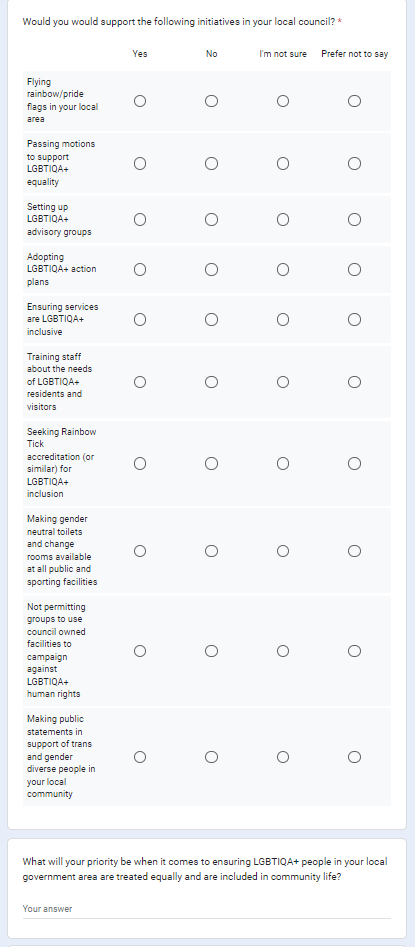
Dean Hurlston: They set up a program where all candidates in the 2020 elections were asked a series of questions and were asked to actually sign up to the Rainbow Votes program. That program would essentially then say, you said yes you would, no you wouldn’t or you didn’t answer. And that enabled anyone who wanted to, to look at any candidate in any council and determine what their LGBTQ stance was. For many candidates they were quite happy to say of course I’m pro gay, of course, I don’t have an issue.
Stassja Frei: They asked candidates to sign their Rainbow Pledge. First and foremost, the pledge meant that if elected, you would campaign for your local council to undertake Rainbow Tick Accreditation. Similar to ACON’s Pride in Diversity, this is another social engineering program designed to shape the beliefs and values of Australian workers. This one targets health and human services organisations like local councils.
Just like the Safe Schools program, Rainbow Tick was created by La Trobe university’s ARCSHS.
So that was the first item on the Rainbow Pledge.
The second item was to establish an LGBTQIA+ advisory committee.
Dean Hurlston: There would be a gay reference group that would be advertised and volunteers from that local municipality would fill those positions and they would look at every policy, every decision that the council was making and apply an LGBTQIA+ view to that policy – did it need to change, was something else needing to be included, etc etc. Nothing wrong with that, but what it means is, once you agree to that, you have to put every decision of council through that lens and it may fundamentally shift some core things. The problem with that is it’s giving one group the ability to really change policy midway through a process. That’s quite dangerous in the context of making council decisions.
Stassja Frei: And just like that, La Trobe’s ARCSHS established something like an upper house made up entirely of queer theorists, in local councils.
Dean Hurlston: So it’s been very successful but it’s created, almost like a secondary check on every decision for one specific group. And for me as a gay man, I kind of feel like it’s a bit disingenuous. It’s not needed. Of course consult the gay community, of course consult the people that something effects, but why do we have to consult one group on every decision when we’re not consulting other groups? What about the different religions? What about immigrants from overseas? There’s so many-what about women? There’s so many ways we could carve that up that we could have an advisory committee checking on everything and we could get nowhere.
Stassja Frei: One local government where eight of the nine elected councillors had enthusiastically signed the Rainbow Pledge was the City of Port Phillip. It’s an affluent, progressive, beach side council that considers itself the heart of pride in Victoria. But when it came time to actually implement the items in the pledge, there was a problem. It was going to cost ratepayers $200,000 over two years. And Port Phillip had already eliminated 62 full time positions due to the financial strain of covid.
Dean Hurlston: I think if you’re going to use any sort of instrument like a, you know, like that tool of saying, sign this pledge and then I’ll bludgeon you with a quarter of a million dollar bill, it’s really disingenuous. I don’t think that was the intent of the pledge but it then became a political tool and it was used in acts of political bastardry against people who were saying, we’re not homophobic, we’ve signed the pledge, we just didn’t know that there was going to be this push for us to spend a quarter of a million dollars, and we need to do that very carefully because it’s community money. To then have people like Tim Baxter say things on social media and you know, in a sense call those councillors homophobic is really disingenuous and offensive. And again, the best action there would’ve been shut up and let the councils work through their position, the money and whether there was a good benefit.
Stassja Frei: Port Phillip council voted against implementing the pledge. Greens Party member Tim Baxter voted in favour and was furious. He told the Star Observer that, quote “I wouldn’t blame anyone from the LGBTIQ community for feeling like they’ve been taken for granted.” End quote. What’s laughable here is that the City of Port Phillip spends about $180,000 each year on the annual pride march. It splurged $28,000 on a rainbow crossing, which, for those who don’t know, is a pedestrian crossing painted in rainbow colours. And, it’s home to the Victorian Pride Centre which the City of Port Phillip contributed $13 million towards.
Dean Hurlston: What I was concerned about with that, is it’s an extraordinary amount of money. It wasn’t one million dollars, it wasn’t a half a million dollars, it was an extraordinary amount of money and a piece of land. For something like that to be donated, when it’s been paid for and raised by rate payers, yes, I get there’s a huge LGBTQ+ community in Port Phillip, but to just give that away is actually really irresponsible of any council. What they should’ve done is gone to their community and said, we actually want a community vote. And if the community went, you know what, overwhelmingly we want it, donate away. That would’ve at least given it credibility rather than we’re just going to take this asset of council’s and throw it at somebody. Because whilst of course I care very much about the LGBTQ community, there are so many others that also deserve a lot of help from you know any council or level of government. Who else should get money? Who else should get land? Where does that stop? The role of local council isn’t to give away community assets.
Stassja Frei: This is the same Victorian Pride Centre that we heard about in Episode 4. They were the ones who cancelled a booking request from Lesbian Action Group because they wanted to hold an event for lesbians born female. The Pride Centre refused the booking on the grounds that it would be discrimination to exclude men who say they’re lesbians.
Two weeks after Port Phillip council voted against Rainbow Tick Accreditation, lawyers had been consulted, the initial vote was declared invalid, and once again, the motion was put to a vote. This time they had the numbers and the City of Port Phillip signed on to get the Rainbow Tick of approval.
Interestingly, four years later, for the 2024 Council elections, Rainbow Local Government updated their Rainbow Pledge. Councillors that signed on would no longer have to push for Rainbow Tick Accreditation. I can’t help but wonder whether the debacle with the City of Port Phillip played a part in this decision. The Rainbow Tick part of the pledge was replaced with the demand that local governments install a rainbow crossing in their community.
******
Another council that signed the 2020 Rainbow Pledge and followed through, is the rural city of Ballarat. It’s about 2 hours outside of Melbourne with a population of 117,000. They set up an LGBTIQA+ Advisory Committee and, as per the Rainbow Pledge, that committee developed an LGBTIQA+ Inclusion Plan. When the draft plan was released for public consultation, there were some alarming items. For example, quote “Review Council’s Public Toilet Strategy to ensure appropriate provision of facilities for all genders.” End quote. In everyday language, this meant either all toilets were to become unisex or men who say they’re women, would be welcome by council to use the women’s facilities.
Similarly, all council policies, programs, facilities and services would prioritise inclusion. So men who say they’re women would be included in any programs or services meant for women. And vice versa, for women who say they’re men.
And then there was the definitions page. Gay was redefined to mean, quote “A term that refers to an individual who identifies as a man and is sexually and/or romantically attracted to other people who identify as men.” End quote.
Dean Hurlston: That’s incredibly over complicated. That’s incredibly, the language there is exclusionary and what I mean by that is, you know, I’m maybe a traditional gay man, I’m a man, a biological man, who likes biological men, that does not mean I’m anti trans, that does not mean I don’t care for them, it means that I’m not sexually attracted to somebody who is not a biological male, and I have no shame saying that. If I have to nuance my language and say, that definition, then I don’t want to be labelled gay because it just completely fundamentally misses what I am.
Stassja Frei: The definition of lesbian was equally as tortured. After much protest from local lesbians that this was deeply lesbophobic and meant any man with a beard could be counted as a lesbian, the final Ballarat inclusion plan simply didn’t include the glossary. As a result, the words gay and lesbian do not appear at all in the main body of the document. They only appear in the footnotes.
In January 2022 the Ballarat Times published an article celebrating the City’s inaugural LGBTIQA+ Advisory Committee. They spoke to one of the committee members, Jay Morrison who said he wanted to make Ballarat a safer and more inclusive place for the LGBT+ community. In 2020, Jay had tried for a spot on the Ballarat city council but was unsuccessful. Jay Morrison’s partner just happens to be Sean Mulcahy. The same Sean Mulcahy from La Trobe university who created the Rainbow Local Government program. So to be clear, Sean Mulcahy convinced the City of Ballarat to sign his Rainbow Pledge which led to the creation of the LGBT+ advisory committee that his partner Jay then became a member of.
At the time he joined the committee, Jay was the director of Ballarat’s annual Frolic Festival which showcases LGBT+ art and culture. Jay was now sitting on a committee where he could directly influence council decisions relating to his Frolic Festival. Whether he did or not, we don’t know. Because the minutes of those meetings aren’t available to the public. I was told I would need to submit a Freedom of Information request to access the minutes.
Dean Hurlston: They’ve had a main seat at the table on many of these issues and through things like the Rainbow Accreditation and Rainbow Votes program, what they have really successfully done is infiltrated every council’s thinking and influenced council officers. And I don’t have a problem with that, so long as all voices are at the table. What we’re seeing is they are forming a very powerful narrative in local government and perhaps because the community isn’t aware that they’re such a strong voice, there aren’t any other voices necessarily being listened to that might have different or opposing views. And what that’s not doing is giving us a good outcome for everybody. It’s literally saying, we will almost pander to this lobby because there is no other voice that we have to consider.
Stassja Frei: In October 2024, Victorians once again voted for their local government representatives. And Sean Mulcahy’s partner, Jay Morrison tried for a second time, at a spot on the Ballarat City Council. This time he was successful.
******
The infiltration of the transgender lobby into local government has produced some interesting results. The 2020 Rainbow Pledge demanded the flying of the rainbow flag from council buildings on days of LGBT+ significance. I once sat down and counted the LGBT+ so called days of significance and if you include the entire month of June which is Pride Month, there are 65 days in total. That’s more than two months of every year. And that’s not counting the Victorian Midsumma Festival, the Sydney World Pride festival or Aromantic Spectrum Awareness Week. In case you’ve forgotten, aromantic means people that experience little or no romantic attraction but may still experience sexual attraction, depending where they fall on the spectrum. So that could describe people that engage in a lot of casual sex. I bring all this up because, in honour of Aromantic Spectrum Awareness Week in 2021, the City of Yarra, controlled by the Greens, decided to fly the aromantic flag at the town hall. Local ratepayer, Sonia Mavridis gave the Herald Sun this fantastic analysis, quote: “They’ve lost their fricken minds. I don’t think I’ve ever heard anything so insanely stupid.” End quote.
Another local council that went out of its way to insult ratepayers was the City of Wyndham on the western edge of the Melbourne suburbs. They commissioned artist David Lee Pereira to paint a $90,000 mural on a public wall. The end result, titled Gender Euphoria consisted of native flowers to pay respect to the traditional owners of the land, and in the centre of the flowers, representing gender diversity, were penises and clitorises. Some penises were erect, some were just poking out of their foreskins, and one seemed to show a snail crawling around the base of an erect penis. All genitalia appeared moist.
Dean Hurlston: Well, you know, art work gone wrong. I think there what really happened was a huge stuff up by council, there was a desire obviously to include art and art in public places is you know really good, sometimes we really have to probably do more of that. But I don’t see how any council or any organisation can get the brief so wrong.
How indeed. It’s unclear whether council was aware of all the genitals before signing off. When confronted with the backlash, the artist fell back on the go to defence of trans activists, saying the criticism he’d received was, quote “coated in hate” end quote.
Ridiculousness aside, one of the more sinister aims of Sean Mulcahy’s Rainbow Local Government scheme seems to be to coerce local governments into making public toilets and change rooms unisex. In this, they were aided by the Victorian Labor government’s introduction of the Gender Equality Act 2020. The Act was supposed to improve workplace gender equality in the public sector, universities and local councils. But the Act didn’t define what gender was. Did it mean male and female or did it mean gender identities? To muddy the waters even further, in the name of intersectionality, the Act included a number of measures that had nothing to do with sex. Race, Aboriginality, religion, ethnicity, disability, age, sexual orientation and gender identity were all acknowledged as compounding factors in a person’s experience of gender inequality.
Moira Deeming was an elected Councillor for the City of Melton at the time when councils around Victoria were grappling with how to implement the Gender Equality Act. You might recognise her name. She successfully sued the Victorian Liberal Party leader, John Pesutto for defamation after he publicly smeared her as having associations with Nazis. You might also remember her from season 1 of Desexing Society. Moira was a registered school teacher who was critical of the Safe Schools program. After her concerns about Safe Schools fell on deaf ears, she decided the best way to effect change would be to get into politics. So she ran for local council.
Moira Deeming: I found out that the $150 fee that you pay to run for local government council gets you 300 words sent around to about 20,000 people and I thought, ‘you know what I’m going to write on mine? Drag Queen Story Time is not for kids.’ And I did. And I said you know ‘and biological males should not be allowed in female only spaces.’
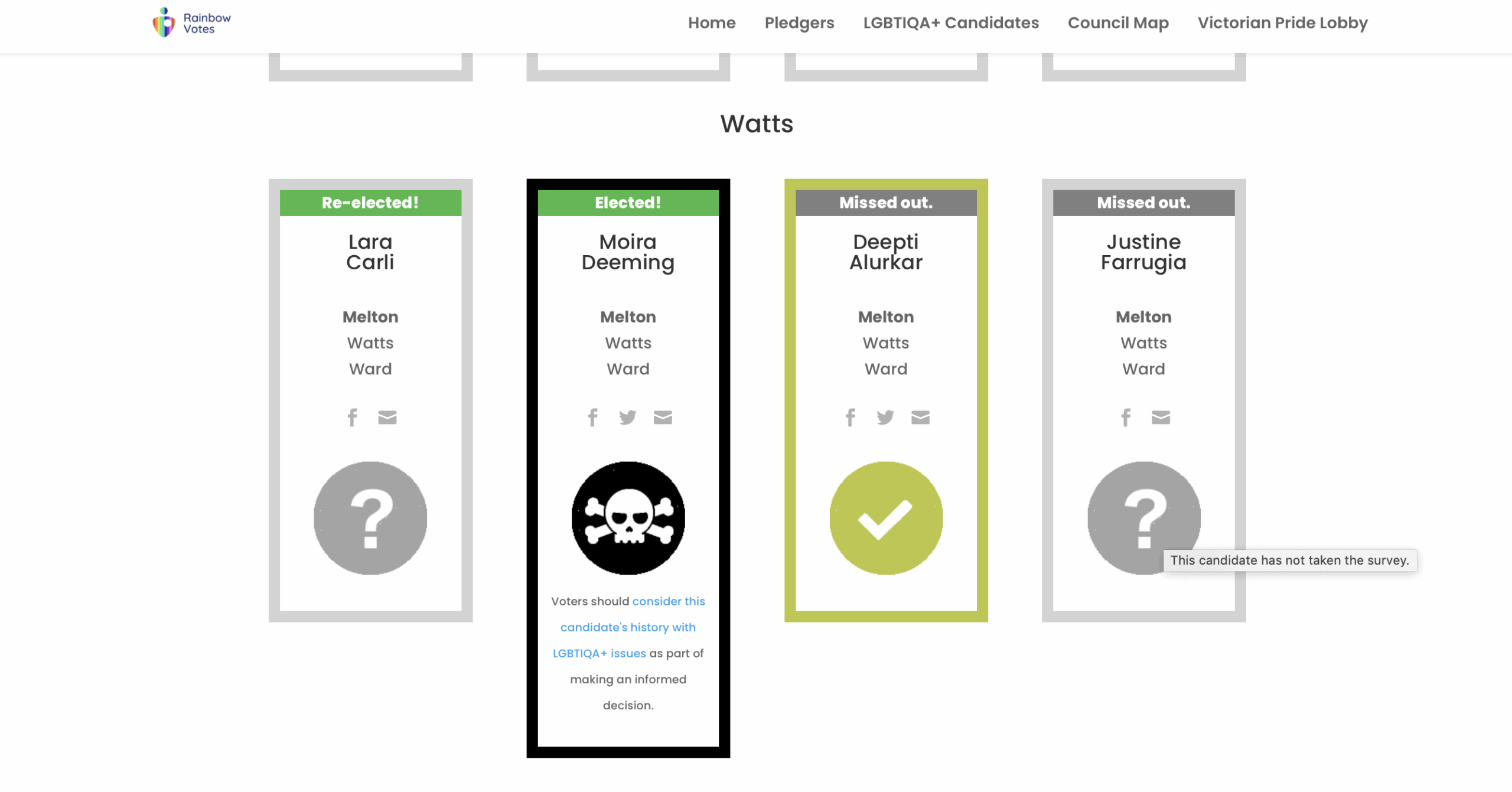
Stassja Frei: On the Victorian Pride Lobby’s Rainbow Votes website they marked Moira Deeming with a skull and cross bones. Despite that, her message resonated with the people of Melton.
Moira Deeming: I had so many sports women, young girls from the soccer clubs around here, writing to me, ‘please, I hope you get in because I don’t like going to my change rooms anymore’ – I’m getting upset now.
Stassja Frei: Councils around Victoria weren’t entirely clear on what they had to do to comply with new Gender Equality Act. No one could give Moira a straight answer. Did all public toilets need to be made unisex or could councils provide male, female and a third, gender neutral option? She asked lawyers, members of parliament and got a meeting with two Victorian commissioners – Todd Fernando, the LGBTIQA+ commissioner, and the newly appointed Public Sector Gender Equality Commissioner, Dr Niki Vincent. Vincent’s role was created specifically to enforce the new Gender Equality Act.
Moira Deeming: and after a long and very tense discussion with her and him, I said, ‘do I have this correct, that I should look at this Gender Equality Act, not as a Gender Equality Act as in serving men and women and you know creating equality there, but as the ‘Gender Identity Equality Act because it’s about gender identity instead of sex?’ and she said yes. And that just blew my mind.
Stassja Frei: It blows my mind too, because the number one objective, written into the Act was to improve the status of women. It’s hard to see how allowing men into the women’s showers at the local pool could possibly improve the status of women.
The answers Moira did get were non answers.
Moira Deeming: ‘Well if a man is in the female toilets you have to assume that that man has the right to be there’ and I thought well that’s pretty unwise I’m certainly not telling my children that. I’m not going to tell my daughter to assume the best of a man that’s in her toilets. No. Why will they not just answer my question? Because if I’m not allowed to provide a separate, sex based space for females then I would lobby for single units, floor to ceiling, sinks outside, no rooms where a female could get cornered or a child could get cornered, like there are ways around it and I would just advocate for that. But if there was a way to provide for both, then I would advocate for that. What I would not settle for is just erasing sex rights and the legislation is worded in such a way that it’s unclear.
Stassja Frei: After repeatedly getting no clear answer on how to proceed, Moira decided to exercise her right as a private citizen.
Moira Deeming: And so I wrote to every single council in Victoria and I asked the same question. You know, ‘what are you doing with your policy? And why or why not. You know what are you doing about it?’ And I basically I just got a whole bunch of abuse back, very bureaucratic speak abuse, which ignored the question. Like 99% of them didn’t even answer the question, we, ah what did they do? ‘we are an inclusive council and we affirm the rights of transgender peoples’ dignity.’ Full stop. And that was their answer to me. And I thought, that’s lovely. Do you care at all about women and the safety of children?
Stassja Frei: Five years later, there’s still no firm answer on what is and isn’t lawful in terms of public toilet provisions. Clarification of the law will probably require legal action. Sadly, it’s not inconceivable that that legal action might come from a woman who’s been assaulted in a public toilet.
When we open women’s spaces to men who say they’re women, we’re also opening the door to predatory men. And as we heard in episode 5 where we looked at the prison situation, some men who say they’re women are also sexual predators.
A 2018 investigation by the UK’s Sunday Times confirmed the obvious – that unisex change rooms put girls and women at increased risk of violence. Freedom of Information documents showed that for the year 2017 to 2018, 134 incidents were recorded relating to sexual assault, rape, voyeurism and harassment that occurred in public change rooms. These were at council run leisure centres and swimming pools. 90% of those incidents occurred in unisex change rooms, compared to only 10% occurring in single sex change rooms.
There are plenty of examples from overseas where men have behaved criminally in women’s spaces. There was of course the Wi Spa incident in the USA where serial flasher Daren Meragher walked naked through the women’s section of a Korean spa with a semi erect penis. And in Scotland there was the case of Katie Dolatowski, a young man who identifies as a woman. He sexually assaulted a 10 year old girl in the women’s toilets at a supermarket. He grabbed the girl by her face, forced her into a cubicle and demanded she remove her pants.
In Australia we haven’t had any significant media coverage of incidents like this.
Rebecca – not her real name – is a Melbourne based personal trainer and fitness instructor who works at council owned leisure centres. These generally include a gym, group fitness classes as well as a public swimming pool.
Rebecca: At every centre I work at, they state that anyone can use the change rooms they best identify with.
Stassja Frei: This of course means that men who say they’re women have started using the women’s facilities.
Rebecca: There was one centre in particular, every time I would- there were no staff toilets so staff would use the main change rooms. Every single time I entered the women’s change room, he was in there, fully clothed in like a long skirt and a jacket. That particular place had the hairdryer attached to the wall. He’d be standing near the wall drying his already dry hair, watching the women and little girls all around him getting changed. The first time I walked in, the first time I saw him, he’s made direct eye contact with me. And that’s not something- I don’t know about you but I don’t make direct eye contact with women in change rooms. Like I’m there to go to the toilet, wash my hands, get out. But it’s like he saw I was staff – and I was new staff at that time – and wanted that validation. And my alarm bells went off. I’m just like, this isn’t right. And I looked to my right, there were three little girls, their mums getting them changed. And I’m like, ‘this, this isn’t- this is dangerous. And I’ve just turned left into the toilets and shut the door and I’m like, ‘that wasn’t a woman.’ I wasn’t prepared to see that when I walked in and as soon as I saw it my heart hurt. My chest was tight.
Stassja Frei: We hear a lot in mainstream media about how men who say they’re women suffer from poor mental health. The message is, that if we don’t include them in women’s spaces, those men will commit suicide. But what we don’t hear about, is the toll that transgender inclusion is having on women’s mental health. Women are expected to ignore our gut instincts that tell us that these men are dangerous. Even when it’s blatantly obvious that they’re flashers and peeping toms.
Rebecca: Now this was a place that there seemed to be a large demographic of women who would bring in their entire bathing routine. So often you know they’d be in there for hours, you know, spend a significant amount of time undressed. He would watch. And the other thing I noticed was that he was always there after the children’s swimming lessons finished. Little girls taking their bathers off; their mums helping them get dressed, getting them showered. These little girls aren’t’ wearing anything and his hair’s dry. He’s just watching.
Stassja Frei: Rebecca did what any new employee would do.
Rebecca: Initially I spoke to my co-workers. All of which seemed quite dismissive of it. That he’d been using it for a while and that he had permission. It was made very clear he had permission. And when I brought up how I felt he was watching, just standing there watching, I was told- no one wanted to talk about it. I even discussed it with my Health Club Manager and he didn’t want to discuss it either.
Stassja Frei: If any other man was loitering in the women’s change rooms, staring at girls and women, police would be called and he would probably be arrested. But when a man declares himself transgender, he can commit certain crimes with impunity. Crimes like voyeurism, indecent exposure and sexual harassment. People become afraid to say or do anything because they know they’ll be called transphobic. It leaves women feeling powerless.
Rebecca: I didn’t put in an official complaint. The main reason being that it’d been made very clear that he had permission and as a casual employee I was very aware that my shifts could be taken away. But I do know female members of this facility had put in complaints. There was a lady that did approach me and goes ‘do you know there’s a man using the change rooms?’ And I had to- I did say ‘look, I’m aware of an individual but to the best of my knowledge he has permission.’ She seemed disappointed with that answer and in that moment I was trying to sort of just be as honest as I could but save face as well and just- cos at the end of the day permission had been granted by council.
Stassja Frei: And this is the crux of the problem. Gym managers are also powerless to do anything about these men because if they did, they would likely lose their job and be dragged before a Human Rights tribunal.
Victorian local councils are allowing men into women’s change rooms because that’s how they’ve interpreted the Gender Equality Act. And the Gender Equality Act is a piece of legislation that has trickled down from the 2013 amendments to the federal Sex Discrimination Act. In order to restore women’s right to single sex spaces and services, it’s this federal legislation that has to change.
In the meantime, if you’ve encountered a man in the change rooms at your gym, Rebecca has the following advice:
Rebecca: Put a complaint in writing to that centre. If it’s a council run centre put another complaint in to council, keep a copy of that because it’s funny how these sort of complaints or emails seem to disappear.
******
Stassja Frei: Alex grew up in Oakleigh, a suburb about half an hour from Melbourne, so she knows the area well. She still visits regularly as her parents and sister live there. So when she received a text message from a friend, alerting her to a Monash City Council advertisement for Drag Queen Story Time, she decided to make some enquiries.
Alex: I rang the library and I rang the council and they weren’t helpful at all, they were actually quite dismissive. Ah, quite arrogant and it was more like well if you don’t like it, don’t come. And I thought ok, yeah nah not going to accept that.
Stassja Frei: With phone calls getting her nowhere, she took the next step of emailing the library, the local councillors, her state MP and every Christian school in the City of Monash. None of the schools responded. The replies from local government were typical.
Alex: Just long paragraphs on diversity and promoting inclusion and educating the younger generation, just all this fluffy stuff that I wasn’t willing to accept. The local MP which was Steve Dimopolous he didn’t respond however he got one of his minions to respond and he was actually quite- he was arrogant enough to say look it’s happening, there’s nothing you can do about it and we hope it’s a raging success.
Stassja Frei: Alex could’ve given up here, but she didn’t. One Friday afternoon she decided to create a change.org petition calling for the event to be cancelled.
Alex: It just kept clocking over, people signing and sharing it and before I went to bed there was over a thousand signatures and then I woke in the morning and it was quite early and I thought oh let me check and see where it’s at and it was gone. It was just gone. No notification nothing.
Stassja Frei: This isn’t surprising for change.org. Although their Community Guidelines don’t specifically mention drag queens, their hate speech policy does cover sexual orientation and gender identity. They simply do not platform anything critical of the trans agenda.
Alex: Well what can I do? What’s a popular talk back radio station in Melbourne? Neil Mitchell. I forwarded my emails onto him. Didn’t get a response. So then I was at work, I think it was a Tuesday or a Wednesday, I get a text message from sister in law saying, hey, that drag queen that’s coming to Oakleigh, she’s talking to Neil right now and that’s when, um how do I put it, it just lit a fire in me. Because I had emailed him that Saturday before and three days later they hadn’t bothered to respond to me but they were interviewing the drag queen.
Stassja Frei: To his credit, Neil Mitchell didn’t give drag queen Sam Thompson an easy run.
Sam Thompson: Like ya know for the parents probably might have like LGBT kids that want to know that there’s like a family of support rock for them out there-
Neil Mitchell: But not at age 1 to 6
Sam Thompson: Well I mean I, I, like, not that they would even know at that age I guess but like some people might, but I guess it’s just more so the fact of like having a glittery drag queen there spreading like imagination and joy like I don’t think, it’s getting read into a bit too much I think, people are thinking that we’re trying to ya know persuade them into certain ways of thinking, I mean I would love to see if I was a kid 1 to 6 a beautiful glittery dress and someone expressive and ya know, them sharing fun like-
Neill Mitchell: I’m not saying you’re trying to convert them but you’re attempting, perhaps in a sense, what are you trying to do, you’re trying to legitimise what you’re doing?
Sam Thompson: No I think just to make them feel safe, I think like there’s a lot of stuff happening in the world at the moment and just to know that there are people out there who ya know yeah can accept them for who they are or, just that they just have fun ya know what I mean like-
Neil Mitchell: Is this something that really most kids have to worry about between the age of 1 and 6?
Sam Thompson: Well I think it’s more so the lack of the parents not doing their job then if they, like, the thing is, people that I’ve seen in some of the comments they’re like oh, ya know, this is a bad choice to educate them, it’s not, I’m, I’m, I’m simply reading a book if you can’t educate your kids then I’m doing your job for you.
Stassja Frei: There you have it, a bullet proof, well reasoned argument for why drag queens should have access to your children. Sam Thompson is doing your job for you, you bad parents. He’s offering your 1 to 6 year old child safety, and the knowledge that there’s a glitter family out there in the world that will adopt your child when you reject them. He’s not trying to convert children, he’s spreading glitter, fun and expressiveness.
So what is the problem with Drag Queen Story Time?
Alex: It’s highly sexualised content. And look, if you’re an adult and you want to go see a show, you’re an adult, you do you, it’s a free country, I’ve got no objections. And these drag queens perform their shows every week you know in the city, in Prahran, no one’s objecting to that. You don’t see protests outside those venues. But when they want to come into our local libraries which our rates fund, and they promote it to kids aged 1 to 6, and they’re not reading The Very Hungry Caterpillar, they’re going to read books on transgenderism and gender ideology, that’s where we as adults and as a society we need to draw the line, like, what’s going on here?
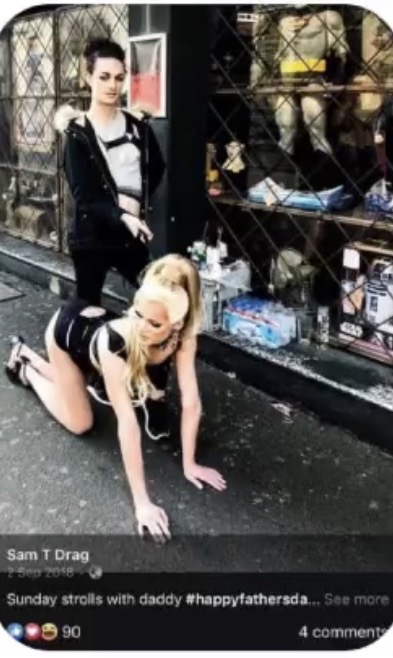
Stassja Frei: Alex sent me some screenshots of drag queen Sam Thompson’s social media. One image shows him in drag, on his hands and knees on the footpath out the front of a shop. He’s wearing a dog collar, a leash, and a person of indeterminate sex is holding the leash. The caption says “Sunday strolls with daddy” hashtag, happy father’s day.
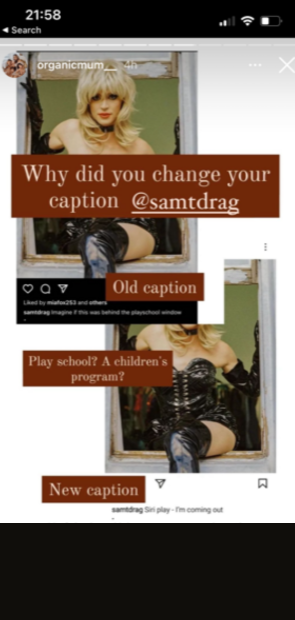
In another he’s dressed like a dominatrix with one thigh high booted leg hanging out of a window frame. The caption reads “imagine if this was behind the playschool window”. End quote. At some point, probably once there was media attention on him, it must’ve dawned on Sam that this wasn’t a good look for someone wanting to read books to children. So he changed the caption to “I’m coming out”.
Drag queens overseas have been filmed performing some…kind of leud acts in front of children. For example, teaching children to twerk and performing quasi stripper routines like removing one’s skirt to reveal a g string worn over tights. And there’s plenty of footage of children throwing dollar bills at dancing drag queens as though they’re at an actual strip club. And no, that last one wasn’t at a Drag Queen Story Time event, but still, it’s just another example of why drag queens should stick to adult venues.
Perhaps the most infamous case of a library getting it completely wrong, was the rainbow dildo butt monkey incident. This was a library in England who hired a man to read to children aged 4 to 11. And for this children’s event, he wore a furry rainbow suit that included protruding fake nipples, fake buttocks and a swinging dildo attached to his crotch. On this occasion, rather than accuse the outraged public of bigotry, the library apologised. It’s these sort of exhibitionist displays that have led to drag queens being labelled sex clowns. Where clowns were once the most popular children’s entertainers, now it’s the sex clowns.
Not only is drag hypersexualised, feminists have long pointed out that it’s a hypersexualised degrading parody of women. Drag queens often dress and dance like strippers. Their adolescent jokes are frequently at the expense of women. And while some gay men argue that it’s just their way of hitting back at being bullied and called sissies, I don’t buy it. It seems more like a way for some gay men to say, “we’re not at the bottom of the social hierarchy, women are”. Even their drag names are often chosen to belittle women. Pussay Poppins, for example. That’s a drag queen who read to children at Launceston Library in Tasmania. Other examples include Terra Hymen, as in tear a hymen. Anna Bortion. So clever. There’s even one that calls himself Malestia Child.
I asked Moira Deeming why she drew attention to Drag Queen Story Time when she was running for local council.
Moira Deeming: The main issue with Drag Queen Story Time is obviously that it’s the equivalent of blackface. We know that that’s inappropriate we wouldn’t entertain children with blackface we shouldn’t entertain them with drag queen entertainment either. You know, one is racist, one is sexist and in addition, Drag Queen Story Time, some of the stories that I’ve seen would really confuse children about the reality of their bodies and about sex and that you can’t change your sex by changing what you wear or changing what you look like
Stassja Frei: Introducing children to the concept of transgenderism seems to be one of the main goals of Drag Queen Story Time. The librarians at Oakleigh Library had chosen a book called She’s My Dad to be read to the 1 to 6 year olds. Here’s an excerpt read by a child on YouTube:
Child: My dad’s name is Haley. She used to be a he, but now she is a she. Last year she did this thing called transition. She grew her hair long, painted her nails in bright colours and started wearing different clothes.
Stassja Frei: As always, transgenderism sends children the dangerous message that not conforming to sex based stereotypes means you might be transgender.
******
Word was starting to spread about Monash City Council’s Drag Queen Story Time. Another concerned mum reached out to Alex and eventually they met up for a coffee. They brainstormed ideas for what to do next.
Alex: We thought well there’s a council meeting coming up, let’s take it to them. Because before that there was a lot of talk online about going there on the day of the reading, which was May 19th and in my brain I was thinking, it’s too late to go on the day, we’ve got to try and stop it beforehand, because on the day you’re going to have kids there and as a mum I care about kids being caught in the crossfire.
Stassja Frei: Alex estimates that about 200 people turned up to the council meeting. Doors were meant to open at 6:45pm but police stood guard, preventing anyone from entering the building. It was reported the next day that council spent half an hour deliberating on whether to cancel the meeting, which is extraordinary. These were rate payers who had shown up to have their say, which is their democratic right.
The doors finally opened and the protesters filed in, along with a group of about 20, pro drag queen counter protesters. And among the small, pro drag queen group was, none other than, Sean Mulcahy.
Alex: Our old mate Sean, who’s not a Monash resident, he had submitted questions, he put a call out, either on his Twitter or Facebook page for Monash residents to contact him so he could submit questions on their behalf. Which is what he did and some of the questions were really ridiculous, like, can we fly a rainbow flag outside council chambers, stuff like that, really inane ridiculous stuff and then lots of questions about LGBTQ rights.
Stassja Frei: Monash City Council is a member of Sean Mulcahy’s Rainbow Local Government scheme. They had signed the Rainbow Pledge and implemented it. Drag Queen Story Time was fulfilling their promise to celebrate LGBT+ days of significance. It was to be held on IDAHOBIT day, which despite its name, has nothing to do with hobbits. It’s the International Day Against Homophobia, Biphobia, Intersexism and Transphobia. It’s unclear whether Sean Mulcahy personally influenced how Monash councillors ran the meeting that night. But their decision to respond to copious questions on LGBT+ rights seemed purposefully designed to antagonise the crowd.
Alex: So we knew of at least 17 questions from our side, regarding the Drag Queen Story Time. So what they did was they lumped all the questions into one and then provided this ridiculous response which pretty much just in a nutshell, the crux of it was it’s going ahead, there’s nothing you can do about it, we’ll do a risk assessment after the event and children are never too young to receive such messages. And that when we just, we, we lost it.
Monash City Councillor: Monash council is committed to child safety and all events and programs are [booing]…including the requirement for working with children checks. The books being read are chosen by our qualified and experienced librarians and celebrate diversity and acceptance and will be age appropriate. Children are never too young to receive such messages and [booing].
Stassja Frei: The next day, Sophie Aubrey, writing for The Age newspaper, linked the protesters to the alt-right and conspiracy theorists. This came about because Alex had reached out to a covid anti-lockdown group called Reignite Democracy, for assistance building their Voice for Kids website. Madeleine Achenza reporting for news.com.au claimed that, quote “Police officers were used to control the clashing protesters after members of the anti-drag camp started yelling abuse at the pro-drag and LGBTQIA+ community supporters.” End quote. Meanwhile Neil Mitchell ran with this description:
Neil Mitchell: What happened out at Monash council last night, this has become a bit of a tradition, rate payers revolting. A noisy, reportedly violent protest at Monash I mean it’s happened at Yarra before, this time a hundred protesters chanting, the council meeting called off, councillors say it was democracy closed down.
Alex: There was no mainstream media there on the night, it was Avi Yemini from Rebel News and the Real Rukshan, and you know what, whatever you may think of them, thank god they were there because Rukshan had his camera on, so it was livestreamed so the footage is there for everyone to see. You can’t – even though they did, they called us bigots, they said we were violent, they said we caused a raucous, the proof is in the pudding you can go look up the livestream, we were peaceful.
Stassja Frei: Peaceful, but with a lot of yelling. The angriest outburst was from a red faced man. The footage, captured by YouTuber Rukshan Fernando was the footage that mainstream media ran with the next day.
Angry protester: All disgraceful, every single one of ‘em!
Alex: There was no violence from our end. I stressed from the beginning this was to be a peaceful protest. If you want to cause trouble you’re not welcome. If anything the other side were pretty menacing, they set up their little group behind the chairs and they sort of stood over us and then while we were listening to the proceedings there were a couple of activists, so men dressed as women with full make up, wigs, they would come and just stand directly over us, invading our personal space, recording us, putting cameras in our faces and for me I found that really confronting because I would never do that to another person.
Stassja Frei: This is a common tactic from trans activists. It’s intended to provoke a reaction. It’s the adult equivalent of sticking one’s finger in a sibling’s face and saying “I’m not touching you” when they complain. Thankfully no one reacted.
Within 10 days of the council meeting protest, Drag Queen Story Time was cancelled. But not because of public opposition. Leader of the Melbourne neo-nazis, Thomas Sewell, had caught wind that anti fascists were planning to attend on the day. So he and his pals said they were going to show up as well.
Alex: When is Monash Council going to take any responsibility for the raucous that they’ve created? Cos at the end of the day, they created this, now we’ve potentially got warring sides, we’ve got the far left, the far right, coming to have a confrontation outside a library funded by us that’s across the road from a playground that is full of toddlers and mums with prams every single day. Victoria police was already having conversations with Monash Council saying ‘we can’t protect you’ and that’s when they made the decision to pull the plug.
Stassja Frei: By the time IDAHOBT day rolled around, Eltham library on the outskirts of Melbourne had also cancelled their drag queen library event for children. In response to the two cancellations, then Victorian Equality Minister, Harriet Shing hosted a Drag Queen Story Time at Parliament House. The attendees were mostly Labor MPs, including then Premier Dan Andrews. Wilfully misunderstanding why people object to drag queens performing for children, Shing told the media the following:
Harriet Shing: We will never ever let a small hate filled rabble take away from our joy and our pride, our dignity and our wellbeing. I can’t think of any better reason to celebrate than today.
Stassja Frei: And what did Alex think of the event?
Alex: It was just meant to be a fuck you to the parents and the people that protested.
******
Stassja Frei: Victoria isn’t the only hotbed of local council trans activism. It’s happening right across Australia. For example, Equality Tasmania, an LGBT+ organisation tried a similar scheme to Sean Mulcahy’s Rainbow Local Government program. For the 2022 council elections they asked all candidates a series of LGBT+ related questions, including whether they would support their council obtaining Rainbow Tick Accreditation.
Meanwhile in New South Wales, the City of Sydney evicted Feminist Legal Clinic from a building the council had provided rent free. This, despite their important work providing free legal advice to victims of male violence and women leaving abusive relationships. Why were they evicted? They had shared news articles related to the clash between women’s rights and men who say they’re women. At the same meeting in which they were evicted, Sydney Councillors signed off on a $500,000 grant to Sydney World Pride.
And then there are the witch hunts where councillors invoke the power of the Code of Conduct to punish their fellow councillors for wrongthink. The most infamous example is the ongoing persecution of Hobart City Councillor Louise Elliott. One of her supposed crimes was saying in a public speech that, quote “trans women are trans women and remain biologically male.” End quote.
But Louise’s story will have to wait for season 3 of Desexing Society.
As for Sean Mulcahy, he’s now set his sights on State government. In 2023 he joined the Victorian LGBTIQA+ Ministerial Taskforce. The Taskforce is a bit like the state government version of the Advisory Committees that Sean seeded throughout Victorian local councils. More specifically, he’s the co-chair of the Justice Working Group which means he’s advising government on civil law, criminal law, policing and corrections. He told the Ballarat Times newspaper that one of the key areas he would be focusing on would be to, quote, “ensure that LGBTIQA+ inclusion is embedded into the laws here in Victoria.” End quote. When queer theorists say inclusion, we all know that means men in women’s toilets, women’s change rooms, women’s prisons, women’s domestic violence services…need I go on?
******
That’s pretty much it for season 2. From the federal level all the way down to local councils, the transgender industry has quite thoroughly merged with government. I wish I could tell you that change is on the horizon but currently in Australia there’s hardly any political will to restore women’s rights. The Liberal Party has been completely missing in action when it comes to opposing the Labor Party’s transgender agenda. Just a handful of conservative MPs and senators have consistently spoken up in defence of women.
There are however some legal cases underway that may bring about change. In episode 4 we heard how the Australian Human Rights Commission denied Lesbian Action Group the right to hold public events without men. The next step in this case will be an appeal in the federal court scheduled for February 2026.
The big one, dubbed the ‘what is a woman case’ is that of Tickle v Giggle. I’ll be covering this in depth in season 3, but here’s a snapshot. Entrepreneur Sall Grover is the CEO of the social media app Giggle for Girls. As the name suggests, it’s intended to be a safe online space just for girls and women. Trans identified male, Roxanne Tickle, formerly Jason, was removed from the app because he’s male. Tickle sued Sall Grover and Giggle for discrimination on the grounds of gender identity. He won the first round in federal court. Sall appealed the decision and that hearing occurred just a week before this episode is airing. We may not know the outcome until early 2026. If Sall is successful, the decision will clarify the meaning of the word woman in the Sex Discrimination Act. Does it mean gender identity or biological sex? If the court decides that woman means a person of the female sex, the hope is that this will have a trickle down effect, triggering amendments to state and territory laws that would be in conflict with the federal Act. The case is still unfolding. If Sall loses her appeal in federal court, she’s said that she’s determined to take it all the way to the High Court of Australia.
Meanwhile overseas, there have been some decisive wins for women’s sex based rights. In January 2025, on his first day back in office, US president Donald Trump signed an executive order titled Defending Women from Gender Ideology Extremism and Restoring Biological Truth to the Federal Government. It stated, quote “Efforts to eradicate the biological reality of sex fundamentally attack women by depriving them of their dignity, safety, and well-being.” End quote. Ironically, Donald Trump, infamously known as the pussy grabber, became a champion of women’s rights. That said, it should be noted that although Trump signed the Order, it was primarily written by lawyer May Mailman, a woman.
The Executive Order defined man and woman the way we’ve always understood them – as biological categories related to sex. It told federal agencies that they would need to adhere to these definitions and stop promoting gender ideology. That meant gender identity would be removed from all federal policies, forms and communications. Federally issued ID documents, such as passports and visas would need to accurately reflect a person’s sex. And, it restored women’s right to single sex spaces, services and sport. But, it’s not without its limitations as Kara Dansky from Women’s Declaration International explained on GB News.
Kara Dansky: The entities that are affected are all federal agencies and anyone that receives funding from the federal government and so the Order includes some very interesting provisions that say that the federal government will not fund gender ideology. In part what that means is that anyone who receives federal money is going to have to reevaluate their policies on protecting so called gender identity and the Order explicitly requires federal agencies to examine their grants to make sure that no federal money is going to fund gender ideology. So it remains to be seen how this will affect, for example, state governments that have protected so called gender identity in the law, we might see some very interesting court battles where, you know blue states such as New York and California that protect so called gender identity might be ready to challenge this administration’s executive order. So we don’t know quite yet.
As Kara predicted, on the 7th of July 2025, California refused to comply with the Order. Incredibly, the hill they’ve chosen to die on, is allowing males to compete in girls’ and women’s sport.
Over in the UK, the organisation For Women Scotland took the Scottish government to the Supreme Court over their definition of woman. This began back in 2018 when the left leaning Scottish National Party passed an Act that mandated quotas for women on all public boards. However, they said that men who say they’re women would be counted as women. Thus they could’ve ended up with a board composed entirely of men that fulfilled the woman quota. For Women Scotland, said, no. That’s not happening. The case hinged upon the definition of woman in the UK Equality Act. Did it mean woman? Or did it mean a man who had a certificate that said he was a woman? On April 16, 2025 the UK Supreme Court handed down its decision.
Lord Hodge: The unanimous decision of this court is that the terms woman and sex in the Equality Act 2010 refer to a biological woman and biological sex.
Stassja Frei: It’s a massive blow to the UK transgender industry. And while Australian women have been cheering on and celebrating these wins, it’s also left us wondering, what about us? What’s it going to take for Australia to say no to the wholesale destruction of women’s rights? Currently, our hopes lie with Lesbian Action Group and Sall Grover’s legal battles. But aside from that, it doesn’t look like anyone is coming to save us. As Kit Kowalski from ACON Exposed points out, that means, it’s up to ordinary women like you and me to take up the fight.
Kit Kowalski:I think what really needs to happen is that women need to lose the shame of standing up for our rights and standing up for our boundaries and once we do that it’ll become a lot easier to fight it.
******
Stassja Frei: Thanks for listening to Desexing Society. Written and produced by me, Stassja Frei. Thank you to my script editor, Ms Edie Wyatt, my sound technician Matthew Friend, and to Dean Hurlston, Moira Deeming, Rebecca and Alex for appearing in this episode.
Thank you to everyone who appeared in Season 2 and to those who generously agreed to an interview but weren’t included in the final cut.
Special thanks to Edie Wyatt, Kit Kowalski and Janet Fraser for your friendship and support in making this project a reality. And finally, thank you to my proof listener, Kate.
For more information or to donate towards this project which I paid for myself, please visit desexingsociety.com. There you’ll find references, links to source material and music used in this series. Stay tuned for Season 3, coming soon.
Credits
Written and produced by Stassja Frei
Script editor – Ms Edie Wyatt
Sound technician – Matthew Friend
Featured: Dean Hurlston, Moira Deeming, “Rebecca”, Alex, Kit Kowalski